TrueNAS — The Ideal Veeam Backup Repository
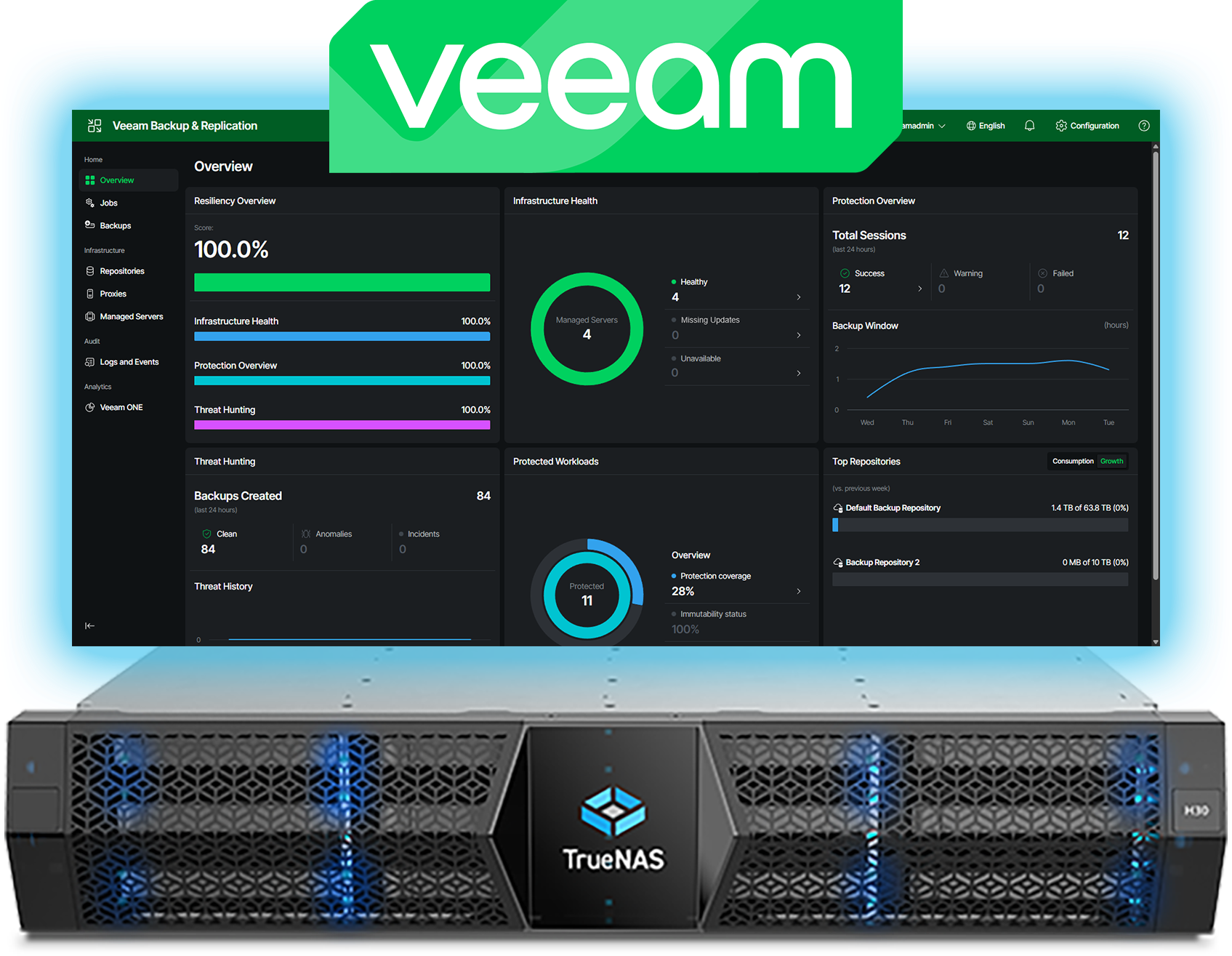
TrueNAS is a certified Veeam Backup & Replication target — present it as a hardened repository using immutable ZFS snapshots, connect over iSCSI, NFS, or SMB, and scale capacity without replacing hardware or replicating to a second site with ZFS async replication.
The Challenge
Veeam Backup & Replication is the most widely deployed enterprise backup platform in the market. But its effectiveness depends entirely on the quality of the repository behind it. A repository that is writable by the production network is vulnerable to the same ransomware that encrypts production VMs. A repository with no snapshot protection means a corrupted backup job cannot be unwound. A repository that runs out of space mid-backup means jobs fail silently until recovery is needed.
TrueNAS addresses each of these failure modes. ZFS snapshots of the Veeam repository are immutable — once created, they cannot be modified or deleted by the Veeam server, the backup proxy, or any process accessing the share. When used as a Veeam Hardened Repository over Linux immutability features, TrueNAS adds a second layer of write protection. Multiple protocols — SMB, NFS, and iSCSI — allow TrueNAS to serve as any Veeam repository type: Windows file share, Linux repo, or block-level backup target. Scale-out Backup Repository (SOBR) support lets multiple TrueNAS appliances appear as a single logical backup destination to Veeam.
How TrueNAS + Veeam + Storj Works

Step 1 — Veeam Backup
Veeam writes backup jobs directly to TrueNAS as a hardened Linux repository over SMB, NFS, or iSCSI.
Step 2 — Immutable Snapshots
TrueNAS automatically creates ZFS snapshots of every backup job, making them immutable against ransomware deletion.

Step 3 — Offsite to Storj
TrueCloud Backup replicates encrypted backups to Storj decentralized cloud — no egress fees, 11 nines durability.
How TrueNAS Integrates with Veeam Backup & Replication
Certified repository support, immutable hardened repo capability, and flexible protocol options for any Veeam deployment architecture.
Hardened Repository and Immutable Backups
Veeam Hardened Repository on TrueNAS — Two Layers of Immutability
ZFS Snapshots as Repository Protection
Immutability Retention Periods
Protocol Flexibility and Repository Types
SMB File Share Repository
Linux Repository via NFS
iSCSI Block Target
Scale-Out Backup Repository (SOBR)
Replication and Off-Site Copy Integration
ZFS Replication of Veeam Repository — 3-2-1 Without a Cloud Gateway
Veeam Capacity Tier to TrueNAS MinIO
Monitoring and Alerting
Trusted by leading organizations


Recommended TrueNAS Systems for Veeam Backup
Models commonly chosen for this workload, with reasoning.
TrueNAS R20
12+2-bay hybrid · 3.4 PB
Veeam-friendly hybrid backup repository — cost-effective per TB with immutable ZFS snapshots over the Veeam jobs.
View R20 →TrueNAS R50
48+4-bay hybrid · 6.5 PB
Larger Veeam backup repository — 48+4 bays for organizations with deep retention and many proxies writing concurrently.
View R50 →TrueNAS H30
2U · 20-core · 8 GB/s
NVMe-accelerated repository for restore-speed-sensitive Veeam workloads — RTO-bound apps get faster recovery.
View H30 →Give Veeam a repository it can rely on
Tell us your Veeam environment, backup job count, data change rate, and retention requirements — we’ll size the right TrueNAS repository and manage the order from quote to delivery.
Recommended Hardware for Veeam Backup
TrueNAS R-Series
Rackmount 1U–4U for Veeam repositories up to 2 PB. R20 and R50 offer a cost-effective starting point for SMB and mid-enterprise Veeam environments with full hardened repository and SOBR support.
View R-SeriesTrueNAS M-Series
Dual-controller HA with NVMe + HDD hybrid storage and up to 30 PB raw. For large Veeam environments where the backup repository itself must be highly available, with fast restore throughput from NVMe-cached frequently accessed restore points.
View M-SeriesTrueNAS H-Series
NVMe-accelerated dual-controller HA with 25 GbE connectivity. Designed for Veeam environments with aggressive backup windows and fast restore SLAs where repository hardware availability directly affects business continuity.
View H-Series