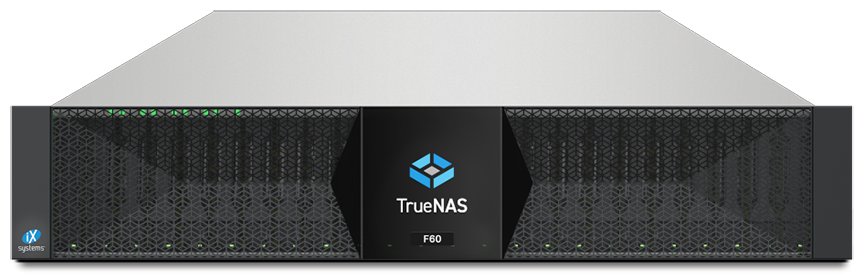
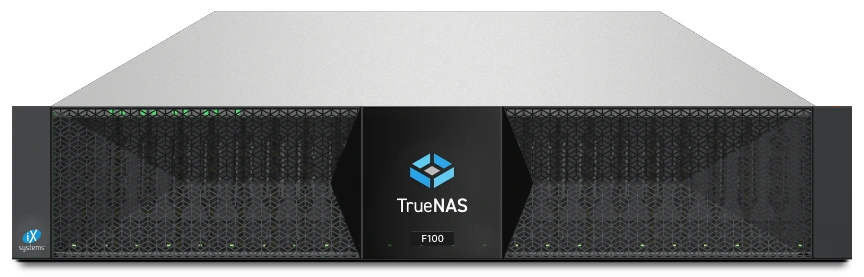
TrueNAS F60 vs TrueNAS F100
Both are 2U all-NVMe flash appliances with optional dual-controller HA, FIPS 140 encryption, and the same TrueSecure compliance posture. They're built for the same use cases — healthcare imaging, financial trading, AI inference — and differ mainly in CPU capacity and effective storage scale.
The F60 ships 32 cores with up to 9 PB effective capacity. The F100 jumps to 48 cores with up to 20 PB effective. Picking between them is mostly a question of whether your IOPS and capacity ceiling matches today's F60 or needs the F100's headroom.
| Spec | TrueNAS F60 | TrueNAS F100 |
|---|---|---|
 |
 |
|
| Form Factor | 2U — 24× 2.5″ NVMe SSD bays (front-loading, hot-swap) | 2U — 24× 2.5″ NVMe SSD bays (front-loading, hot-swap) |
| Controller | 32 Cores (64 Threads) — Dual Controller HA optional | 48 Cores (96 Threads) — Dual Controller HA optional |
| Read Cache | 512 GB DRAM | 512 GB DRAM |
| Max Capacity | 9 PB all-flash (18 PB effective*) | 20 PB all-flash (40 PB effective*) |
| Networking | Up to 4× 10/25/40/100 GbE | Up to 4× 100 GbE or up to 8× 100 GbE |
| Fibre Channel | 4× 32 Gb | 6× 32 Gb |
| View F60 | View F100 |
Which one's right for you?
Choose the F60 if…
- Your sustained IOPS requirement fits 32-core compute on the storage controller.
- Effective capacity targets are under ~9 PB (after compression + dedupe).
- Per-TB price is a meaningful constraint and you want to leave room for a hardware refresh in 3–5 years.
Choose the F100 if…
- You expect to scale past 9 PB effective in this generation.
- Workload concurrency or QoS for many tenants needs the 48-core headroom — multi-tenant analytics, large VDI farms, dense virtualization.
- You want longer runway on a single chassis purchase before re-architecting.
Where they're identical
Both are 2U with 24× 2.5″ NVMe SSD bays (front-load, hot-swap), dual-controller HA optional, FIPS 140 + NIST 800-209 + GP-OS STIG security posture, the same protocols (SMB, NFS, iSCSI, NVMe-oF, Fibre Channel, S3-compatible), and identical drive support up to 122 TB per SSD. If your sizing is in the F60 range today, you can usually start there and move up later — same chassis form factor, same rack, same management.
Need a different shape? The V160 goes hyperconverged with 400 GbE for AI-scale workloads, and the M-Series trades all-NVMe for HA-hybrid economics.
Help picking between F60 and F100
Tell us your IOPS target, dataset size, and growth horizon. We'll size and configure either model and stay on the order through delivery.